- Doubled or tripled in volume
- Bubbly and aerated
- Slightly domed on top
- Smelling pleasantly tangy, not sharp or alcoholic
If your starter is sluggish, your bread will be too.
Step 2: Mix the Dough
In a large bowl, combine:
- 100 g active starter
- 300 g warm milk
- 30 g honey or sugar
- 30 g melted butter
Whisk or stir until mostly smooth. It doesn’t need to be perfect.
Add:
- 500 g flour
- 9 g salt
Mix with a spoon or your hands until all the flour is hydrated and a shaggy dough forms. Scrape down the sides of the bowl. The dough should feel soft and slightly tacky, but not soupy.
Cover and let the dough rest for 20–30 minutes.
This short rest (autolyse-style) allows the flour to hydrate and makes kneading easier.
Step 3: Knead Until Smooth
After resting, knead the dough:
By Hand:
Knead on a lightly floured surface for 8–10 minutes.
By Mixer:
Use a stand mixer with a dough hook on medium speed for 5–6 minutes.
You’re looking for:
- Smooth surface
- Elastic feel
- Dough that springs back when gently pressed
- Slight tackiness, but not sticky
If the dough feels too wet, resist adding flour immediately. Let it rest 10 minutes, then continue kneading. The dough will strengthen as gluten develops.
Step 4: Bulk Fermentation (First Rise)
Shape the dough into a ball and place it in a lightly oiled bowl. Cover.
Let it ferment at room temperature until doubled in size. This usually takes 4–6 hours, depending on:
- Starter strength
- Room temperature
- Dough hydration
Ideal dough temperature is around 75–78°F / 24–26°C.
Optional but helpful: perform one stretch and fold halfway through bulk fermentation to improve structure.
How to tell bulk is done:
- Dough has doubled
- Surface looks smoother and slightly domed
- Dough jiggles gently when you shake the bowl
- A finger pressed into the dough leaves a slow-filling indentation
Step 5: Shape for Sandwich Bread
Turn the dough out onto a lightly floured surface.
- Gently press it into a rectangle roughly the width of your loaf pan.
- Fold the top third down and the bottom third up like a letter.
- Roll the dough tightly from one short end into a log.
- Pinch the seam closed.
Tension is important here. A tight roll ensures an even crumb and good oven spring.
Place the dough seam-side down into a greased loaf pan.
Step 6: Final Proof
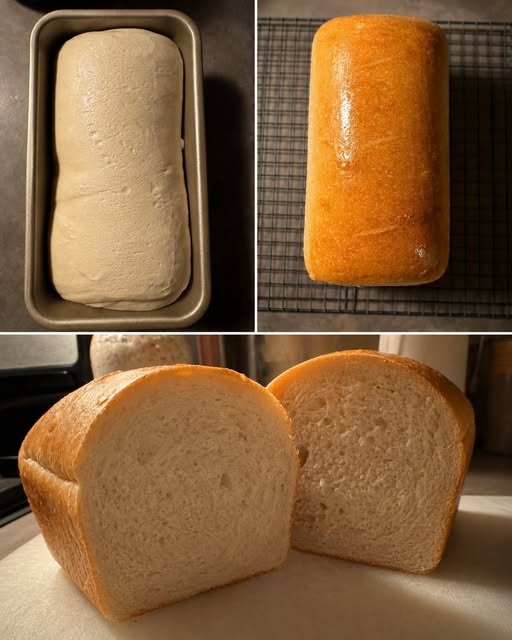
Cover the pan and let the dough rise until:
- The top is about 1 inch (2–3 cm) above the rim
- The dough slowly springs back when gently pressed
This typically takes 2–4 hours at room temperature.
Do not rush this step. Underproofed sandwich bread will be dense and tear when sliced.
Optional overnight proof:
Once the dough has risen about 50–70%, you can refrigerate it overnight. Bake straight from the fridge the next day.