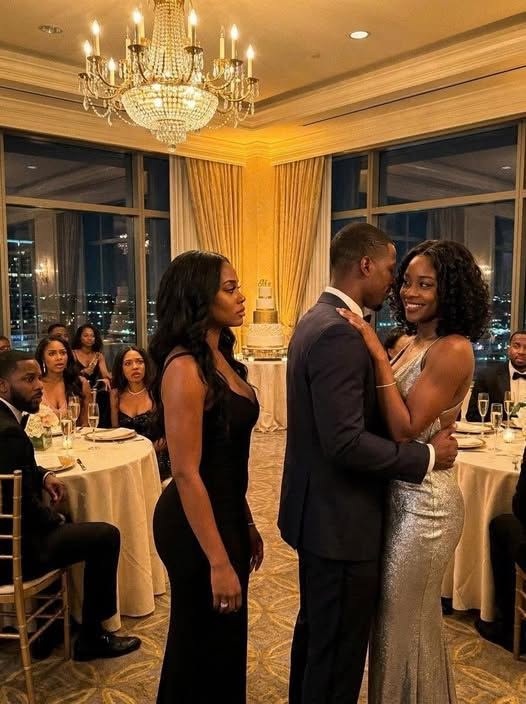
The crystal chandelier above us threw prismatic light onto the polished oak floor of the Weston Hotel’s ballroom, and the soft jazz that floated from the hidden band felt like a lazy river, carrying guests from table to table in its warm current. I was standing near the center of it all, a thin rim of champagne glass trembling in my hand, the cool liquid catching the light as I lifted it to my lips. The scent of fresh roses—white and pink—rose from the towering centerpieces, their petals brushing my nose with a sweet, almost cloying perfume.
Angela was beside me, her dark hair pinned back in a sleek bun, a lawyer’s poise about her that made me think of courtroom dramas rather than anniversary parties. She had been my best friend since college, the one who could read a lie in a second glance and call me out before I even finished a sentence. Her eyes flicked toward the cake, where our names were iced in silver: “Eleanor and Mason. Eight Years. Forever to Go.” The words felt like a promise written in frosting, a promise that suddenly seemed absurd.
Mason was across the room, laughing at something Marissa said. I could see the way his shoulders relaxed, the way his hand rested on the small of her back. It wasn’t a casual brush. His fingers curled around her waist, steady, deliberate. I watched the way his thumb traced a slow line down her spine, and a coldness settled in my chest that wasn’t the chill of the Seattle night outside.
Marissa—my husband’s ex—was wearing a sleek black dress that clung to her figure, the kind of dress that made you think of a night you’d rather forget. She smiled at Mason, a smile that seemed to say, “I’m exactly where you want me.” Her eyes met his, and for a moment they shared a private joke that I wasn’t invited to hear.
Angela’s face shifted first. Her jaw tightened, and the wineglass she held slipped just enough that the stem threatened to crack. “Eleanor,” she whispered, her voice low enough that only I could hear.
I lifted one hand slightly, a silent request for her not to intervene. The room buzzed with soft clinks of glass, the low murmur of conversation, and the faint hum of the air conditioner. I turned, my heels clicking against the floor as I crossed the expanse of the ballroom.
Every detail etched itself into my memory: the soft rustle of silk as Marissa shifted, the faint perfume of her perfume—citrus with a hint of sandalwood—mixing with the rose scent, the way the chandelier’s light caught on the glitter of the cake’s frosting, the way Mason’s cousin’s laugh rose too loud near the bar, the waiter’s tray of crab cakes sliding past as if nothing in the room mattered.
When I reached them, Marissa noticed me first. Her smile faded, a flicker of surprise that disappeared as quickly as it came. Mason’s hand did not move. He kept his grip, as if the very act of holding her was a statement he wasn’t willing to retract.
The Confrontation
I placed my hand gently on Mason’s shoulder, feeling the heat of his skin through his shirt. “Oh, honey,” I said, my voice steady, “do you two need a room?” The words hung in the air, louder than the soft jazz that continued to play.
Conversations around us seemed to halt in an instant. A glass clinked somewhere in the distance, then fell silent. Marissa lowered her gaze, her eyes darting to the floor as if searching for a way out. Mason turned toward me, his eyes glossy from the alcohol, his expression a mix of irritation and something that might have been shame, but was quickly masked.
I waited. I waited for him to step back, for an apology, for any sign that the man I loved still understood the difference between a mistake and a humiliation. Instead, he lifted his chin, the muscles in his jaw tightening, and spoke directly into my eyes, his voice carrying across the room: “If you can’t handle me spending weekends with my ex, go to hell.”
The room didn’t change visibly at first. The music kept playing, the chandeliers still glittered, someone laughed in the corner at an ill‑timed joke. But a ripple of silence spread like ink across a white page, pulling every eye toward us.
Angela stood behind me, her face flushed with fury, her hand still gripping her wineglass as if it might shatter. Marissa shifted away, not out of guilt but out of fear of being seen. Mason, however, held his head high, a proud, almost defiant posture that made the words cut deeper.
It wasn’t the insult that lodged itself in my throat. It was the pride in his voice, the way he didn’t stumble over the words, as if he had rehearsed this moment. He hadn’t slipped; he had announced it.
I stared at him for several seconds, feeling the weight of every shared memory press against my ribs. Then I smiled—not because anything was funny, but because the smile was an acknowledgement of the gift he had just given me, the permission I had been too loyal to grant myself.
I didn’t scream. I didn’t throw my glass. I simply turned, walked past the cake that still bore our names, grabbed my coat from the coat rack, and left the ballroom without looking back.
The Escape
The rain had begun the moment I stepped onto the sidewalk, a steady drizzle that turned the pavement into a glossy black mirror reflecting the hotel’s golden lights. I could still see the ballroom through the tall windows, a perfect scene of elegance that now seemed like a cruel joke.
Angela was beside me, her coat buttoned up to her chin, her eyes searching mine for a hint of what I wanted to do next. She didn’t ask. She simply opened the back door of the hotel and we slipped out into the cold night, the rain soaking through the hem of my dress.
We walked in silence for a few blocks, the sound of our footsteps mixing with the patter of rain on the sidewalk. The city lights of Seattle flickered, the neon signs of bars and cafés glowing like distant beacons. I could feel the wet wind biting at my cheeks, each breath a puff of vapor.
Angela pulled me into a late‑night café near the waterfront, a small place with fogged windows and metal chairs that squeaked when you sat down. The barista, a tired young man with a tattoo of a coffee bean on his forearm, barely glanced up as we ordered. I wrapped both hands around a cup of coffee I never actually drank, the mug warm against my skin.
Angela sat across from me, her eyes fixed on the steam rising from my cup. The café was quiet, the only sounds the low hum of the espresso machine and the occasional clink of a spoon against a saucer. The fog outside pressed against the windows, turning the street into a watercolor of gray and amber.
Finally, I spoke, my voice barely above a whisper. “I’m taking the Singapore job.”
Her eyebrows lifted, surprise flashing across her face. I had rejected the offer twice before—once two years earlier, when an international school in Singapore had reached out with a principal position, promising a better salary, a higher title, and a chance to lead rather than merely survive a school year. Mason had said Seattle was where his career mattered, and I had stayed, convinced that my marriage was the anchor I needed.
The second offer had arrived just a week before our anniversary party. The school emailed again, saying the position remained open, the board still remembered me, and this time the salary was nearly double what I earned teaching third grade. It was a lifeline I had ignored, a door I had kept closed out of loyalty, out of fear, out of habit.
Now, with the rain beating a steady rhythm against the windows, I felt the weight of that decision settle in my chest like a stone. I could hear the distant sound of a ferry horn, the low rumble of the city that never truly slept.
The Flight
The next morning, I booked a flight to Singapore. The ticket cost more than I had planned to spend on a weekend getaway, but the price felt irrelevant. I packed a single suitcase, folded a few shirts, slipped in a copy of “The Art of Possibility”—a book I had meant to read for years—and a small, tarnished silver locket that Mason had given me on our first anniversary, the one I had never opened.
Angela drove me to the airport in her old Subaru, the engine humming softly as we navigated the wet streets. The Seattle‑Tacoma International Airport was a blur of people rushing, announcements echoing, the smell of coffee and pretzels mingling with the sterile scent of cleaning chemicals.
At the security line, I placed my bag on the conveyor belt, feeling the weight of my decision settle on my shoulders. The TSA agent glanced at my ID, then at the locket, and gave me a half‑smile that seemed to say, “Good luck.” I walked to my gate, the boarding pass in my hand feeling like a passport to a new life.
The plane took off, and Seattle’s rain‑smeared skyline faded beneath the clouds. I stared out the window, watching the world shrink into a patchwork of fields and cities, the darkness of night turning into the pale glow of sunrise over the Pacific.
When we landed in Singapore, the humidity hit me like a blanket, warm and heavy. The city was a riot of colors—neon signs in Mandarin, Malay, Tamil, and English, street food stalls exhaling aromas of chili and lemongrass, the constant hum of traffic and conversation.
I checked into a small hotel near the school, its lobby adorned with wooden carvings and a jade plant in the corner. The receptionist handed me a key card, and I walked up to my room, the elevator doors closing behind me with a soft “ding.”
Inside, the room was simple—a queen‑size bed, a desk, a window that opened onto a balcony overlooking the city’s skyline. I placed the silver locket on the nightstand, its surface catching the morning light, and I finally opened it.
Inside was a tiny photograph: a young woman with a bright smile, her hair pulled back in a ponytail, standing next to a man I recognized—Mason, in his early thirties, wearing a navy suit. The back of the photo bore a handwritten note: “To my forever, 2012.” I felt a pang of something I hadn’t expected—no longer anger, but a quiet sorrow for the illusion I had clung to.
In that moment, the locket stopped being a token of love and became a relic of a story that had ended long before I realized it.