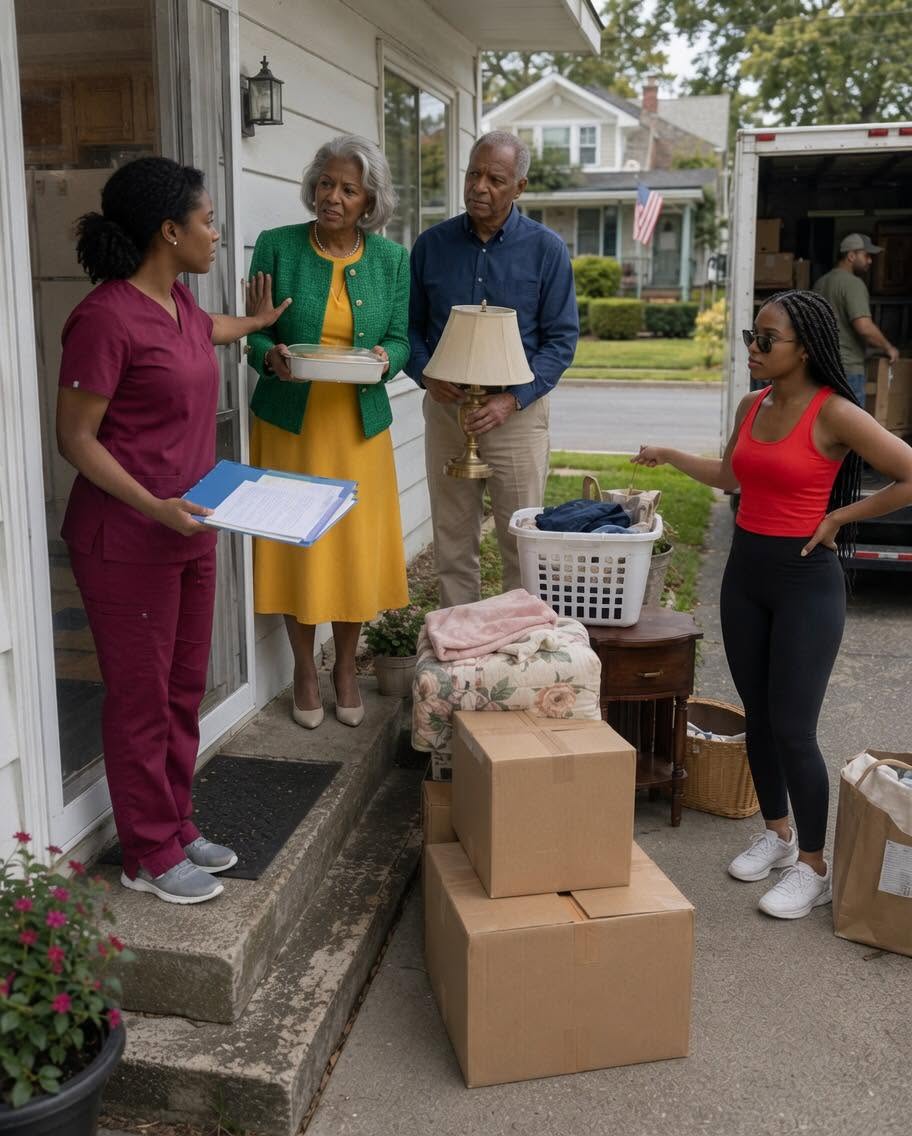
I opened the blue folder.
The first page was the payoff confirmation.
I turned it so they could see the balance.
$0.00.
The second page was the deed copy.
The third was the tax statement.
The fourth was the insurance bill.
The fifth was the loan satisfaction letter.
Everything had my name on it.
Only my name.
Colleen crossed her arms.
“Are you seriously doing paperwork at us right now?”
“Yes,” I said.
My father finally looked up.
His face was red, but not with anger.
With shame.
My mother tried to laugh.
“Oh, honey, nobody is saying it isn’t legally yours.”
That sentence told me everything.
She had already separated legal ownership from family ownership in her head.
She had decided the law was a technicality and guilt was the real deed.
“No one is moving into a house I paid for on my own,” I said.
The words were not loud.
They did not need to be.
Colleen’s face changed first.
Shock became offense.
Offense became performance.
“So I’m supposed to be homeless?” she snapped.
“You have an apartment,” I said.
“My rent went up.”
“So did my hours. So did my insurance. So did the cost of everything I gave up to pay this off.”
My mother made a sharp sound.
“That is your sister.”
“I know who she is,” I said. “That’s why I know she should have called me before hiring a moving truck.”
My father set the lamp down slowly.
It made a soft thump on the porch boards.
That tiny sound broke something open.
He looked at Colleen and said, “You told us she agreed.”
Colleen froze.
My mother turned her head.
“What?” I said.
My father swallowed.
“She said you two had talked,” he said. “She said you were nervous about the change but said yes.”
The driver stopped pretending to read his clipboard.
My mother’s casserole dish sagged in her hands.
Colleen’s mouth opened, but nothing came out right away.
Then she said, “I said she would agree.”
That was not the same thing.
Everyone on that lawn knew it.
I reached back into the folder and pulled out the printed screenshot I had found earlier that day after Nana Ruth sent it to me.
Colleen had texted my mother at 7:12 that morning.
Once I’m in, she won’t make me leave. Just keep Dad unloading.
I had printed it because I knew someone would call me dramatic.
I handed it to my father.
He read it once.
Then again.
The color drained from his face in a way I had never seen.
“Colleen,” he whispered. “You planned this?”
Colleen’s eyes filled fast, but I had known my sister too long to mistake tears for remorse every time.
Sometimes tears were just the first tool she grabbed when the old ones stopped working.
“I’m desperate,” she said.
“No,” I said. “You’re caught.”
My mother stepped between us.
“Enough. We are not humiliating your sister in the street.”
I almost laughed.
Not because it was funny.
Because my mother had missed the whole point.
Colleen had brought a moving truck to my house without permission.
My father had carried her lamp onto my porch.
My mother had come with food and a speech about fairness.
But somehow the humiliation only began when I said no.
I took out my phone.
My mother looked at it, and for the first time, real worry moved across her face.
“Who are you calling?” she asked.
“The moving company first,” I said. “Then whoever I need to call if any of those boxes cross my doorway.”
The driver held up both hands.
“Ma’am, we’re not bringing anything in without the homeowner’s permission.”
Homeowner.
The word landed like a hand on my shoulder.
For nine years, I had been payer, helper, daughter, sister, fallback plan, emergency contact, safe option.
For once, someone named me correctly.
My father stepped down from the porch.
He looked smaller without the lamp in his hands.
“I’m sorry,” he said.
My mother turned on him.
“Don’t you start.”
He flinched, and I hated that I recognized it.
That was the same flinch I had learned in childhood.
The one that said it was easier to let her decide than to survive her disappointment.
But this time he kept looking at me.
“I thought you agreed,” he said.
“I didn’t,” I answered.
He nodded once.